A security dongle must be inserted in the BLUE and RED servers to change configuration.
Prerequisites
Before you configure File Transfer transfer parameters:
Ensure a dongle is inserted in the server you want to modify.
Ensure MetaDefender Optical Diode BLUE and MetaDefender Optical Diode RED network addresses are configured.
Ensure the current license and personality are uploaded.
FTP
FTP must be configured on both BLUE and RED sides . Each side has its own management UI.
You can define several FTP servers in the Optical Diode UI to send files from BLUE to RED. To do so, just follow the instructions bellow.
Go to the management UI and insert user and password to login.
Click the File Transfer link, select the FTP label and then click on the Add FTP Share button.
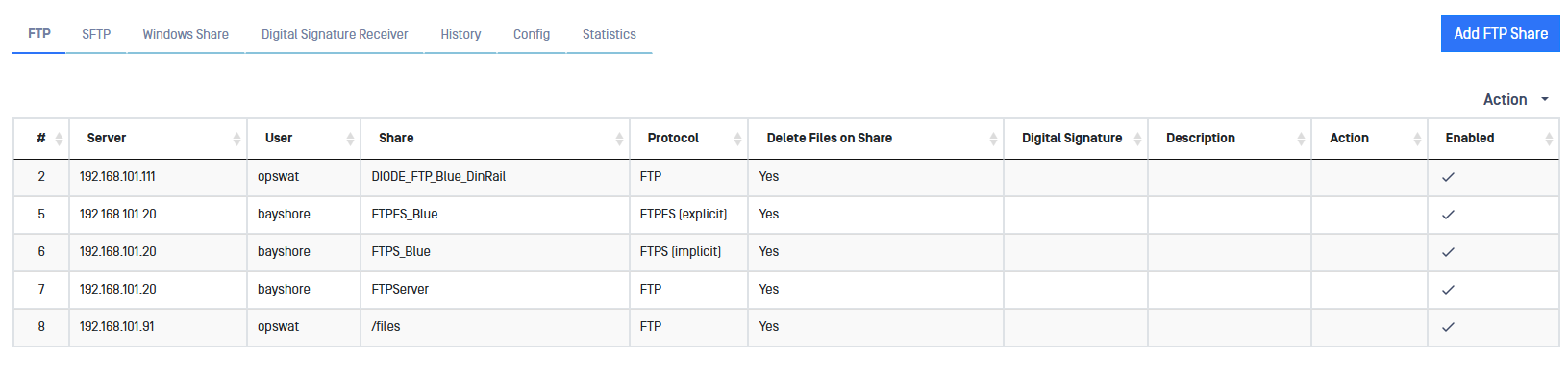
Complete the following fields:
FTP Channel: Assign a channel number.
The FTP Channel Number must be the same on both BLUE and RED sides.
User: Username for FTP file transfer server
Password: Password for the FTP server
Server: Name or IP address for the FTP server
Share: Folder on FTP server. The value can be a folder name or a ‘/’, depending on how you set up file sharing on the FTP server.
Optical Diode BLUE: Location on the BLUE zone server that contains the data to be transferred
Optical Diode RED: Location on the RED zone server that will receive the transferred data
Description (optional): Description of the FTP transfer.
Digital Signature: Choose a Digital Signature to sign to sign the file transfer on the current channel. You can generate or import key pairs on the link next to the icon.
Enabled: File transfer will be enabled if this checkbox is ticked.
Delete Files on Share after Transfer: If this checkbox in ticked, files will be erased from the Share folder once the file transfer have been completed. This option will be present only in the sending side.
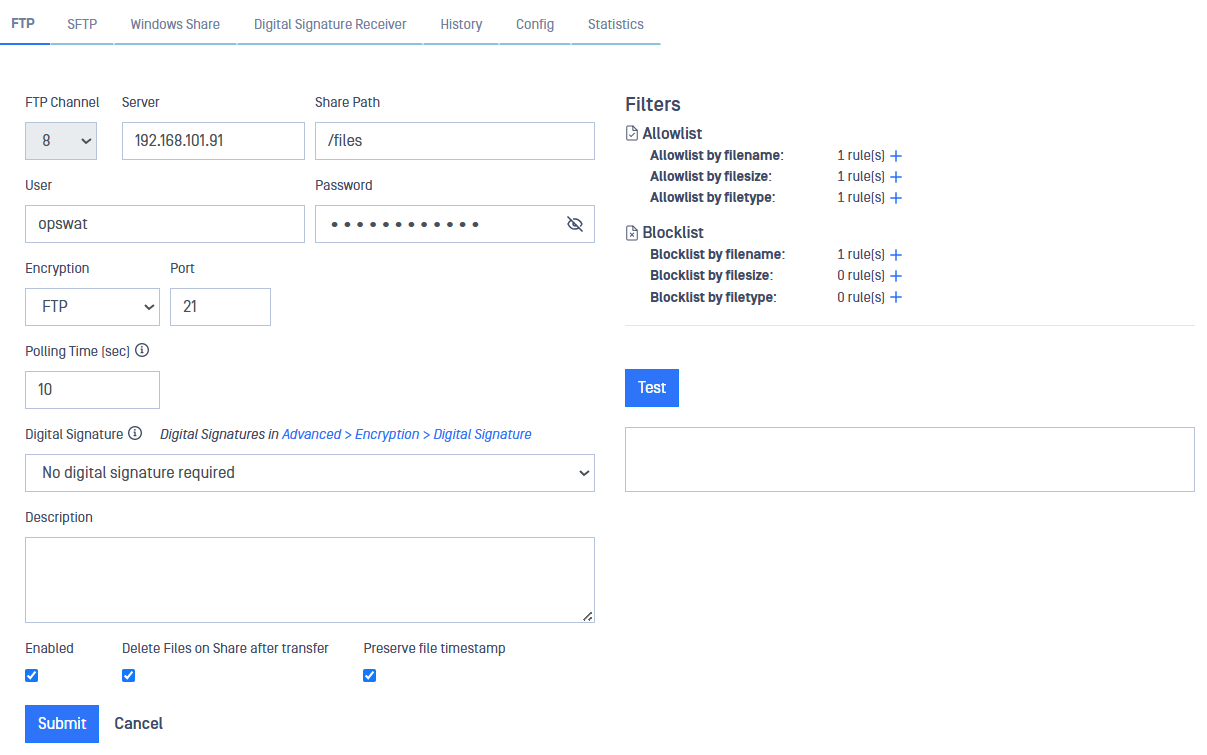
After filling in the fields, click on the Submit button to save configuration.
SFTP
SFTP must be configured on both BLUE and RED sides. Each side has its own management UI.
You can define several SFTP servers in the Optical Diode UI to send files from BLUE to RED. To do so, just follow the instructions bellow.
Go to the management UI and insert user and password to login.
Click the File Transfer link, select the SFTP label and then click on the Add SFTP Share button.

Complete the following fields:
SFTP Channel: Assign a channel number.
The SFTP Channel Number must be the same on both BLUE and RED sides.
User: Username for SFTP file transfer server.
Auth: Select between password or Private Key, Encrypted Private Key or NetWall Generated Keys depending on what is the preferred authentication method.
Password: insert here the password depending on the authentication method selected.
Private Key: insert here the Private Key depending on the authentication method selected.
Server: Name or IP address for the SFTP server.
Port: Default port for SFTP file transfer is 22 but it can be changed by the user.
Share Path: Folder on SFTP server. The value can be a folder name or a ‘/’, depending on how you set up file sharing on the SFTP server.
Optical Diode BLUE: Location on the BLUE zone server that contains the data to be transferred.
- Optical Diode RED: Location on the RED zone server that will receive the transferred data.
Polling Time (sec): How often to poll the file share for new files (default: 10 secs, allowed values from 10 to 3600).
Description (optional): Description of the SFTP transfer.
Digital Signature: Choose a Digital Signature to sign to sign the file transfer on the current channel. You can generate or import key pairs on the link next to the icon.
Enabled: File transfer will be enabled if this checkbox is ticked.
Delete Files on Share after Transfer: If this checkbox in ticked, files will be erased from the Share folder once the file transfer have been completed. This option will be present only in the sending side.
Connection can be tested to check the configuration pressing Test button.
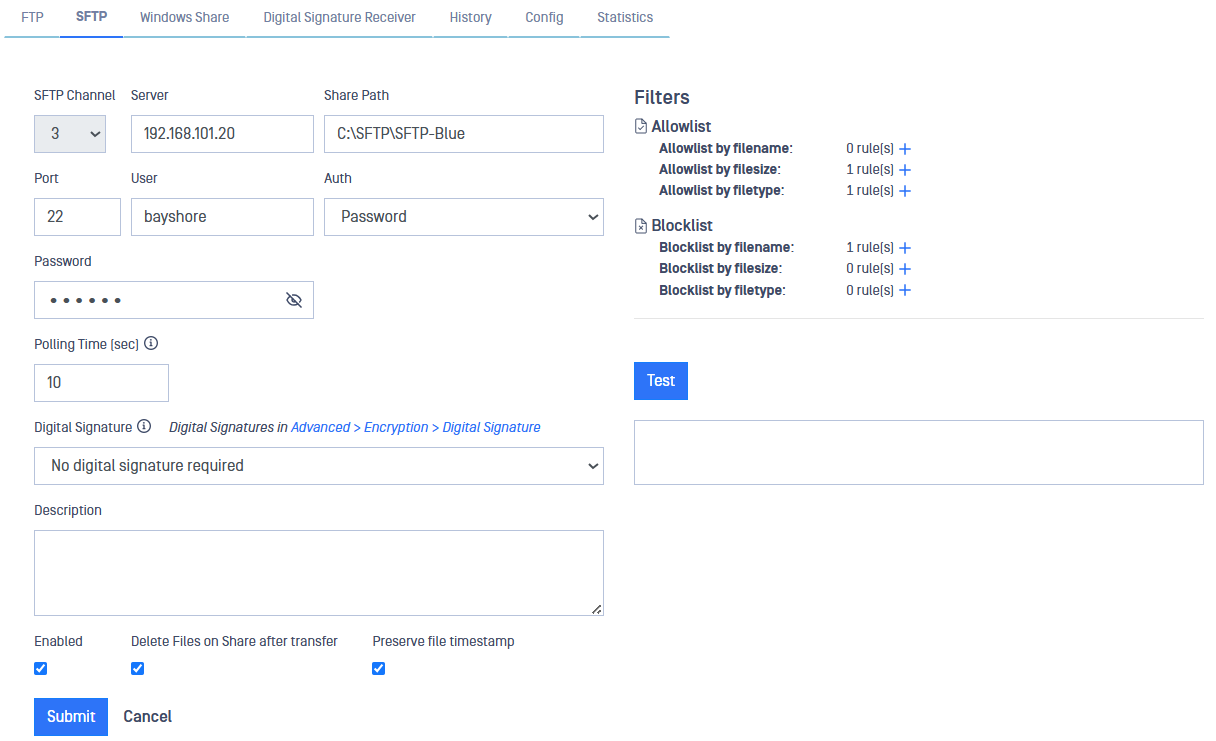
After filling in the fields, click on the Submit button to save configuration.
Windows File Share
Windows File Share (WFS) must be configured on both BLUE and RED sides. Each side has its own management UI.
Go to the management UI and insert user and password to login.
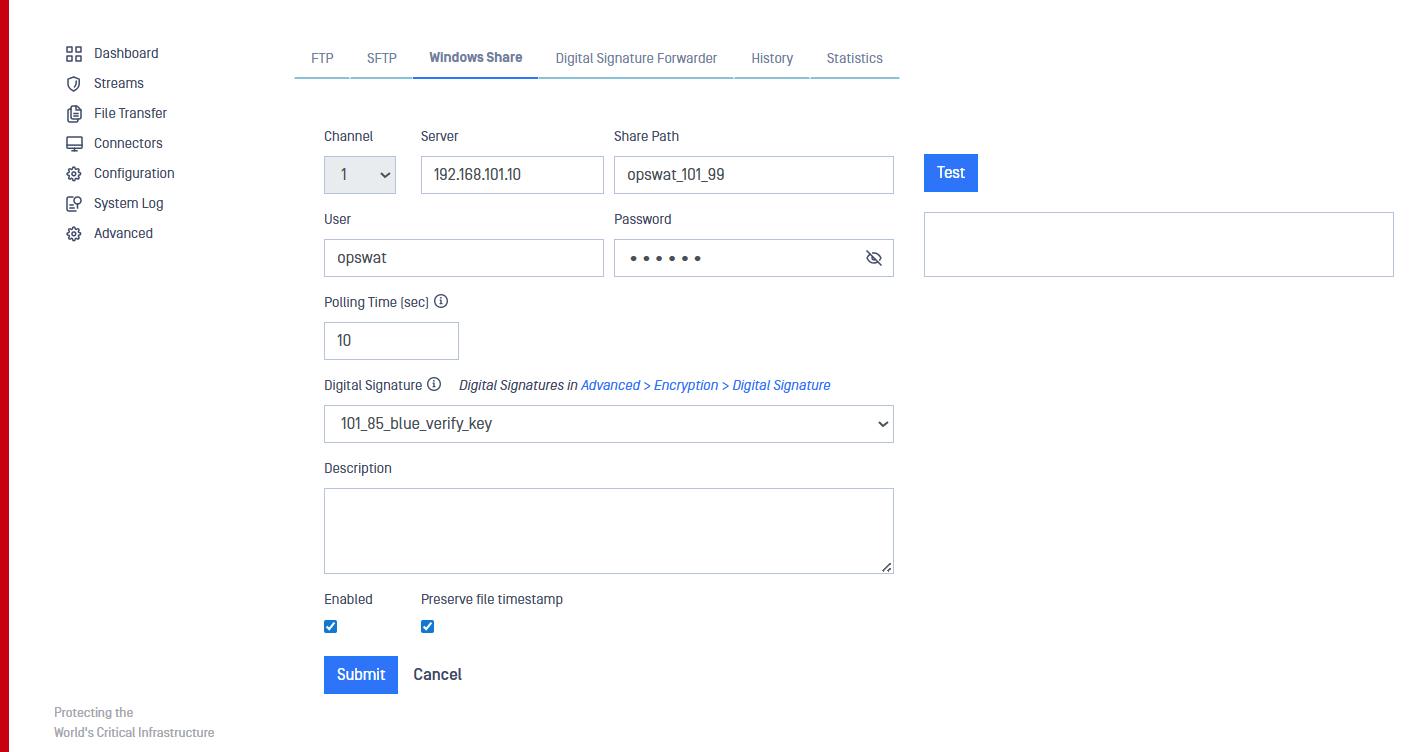
Click the File Transfer select the Windows Share label and then click on Add Windows Share.

Complete the following:
User: Username for the Windows File Sharing server
Password/Re-enter: Password for the Windows server
Server: Name or IP address for the Windows server
Share: Folder on Windows File Sharing. This value must be a folder name
Optical Diode BLUE: Location on the BLUE zone server that contains the data to be transferred
Optical Diode RED: Location on the RED zone server that will receive the transferred data
Description (optional): Description of the Windows Share transfer.
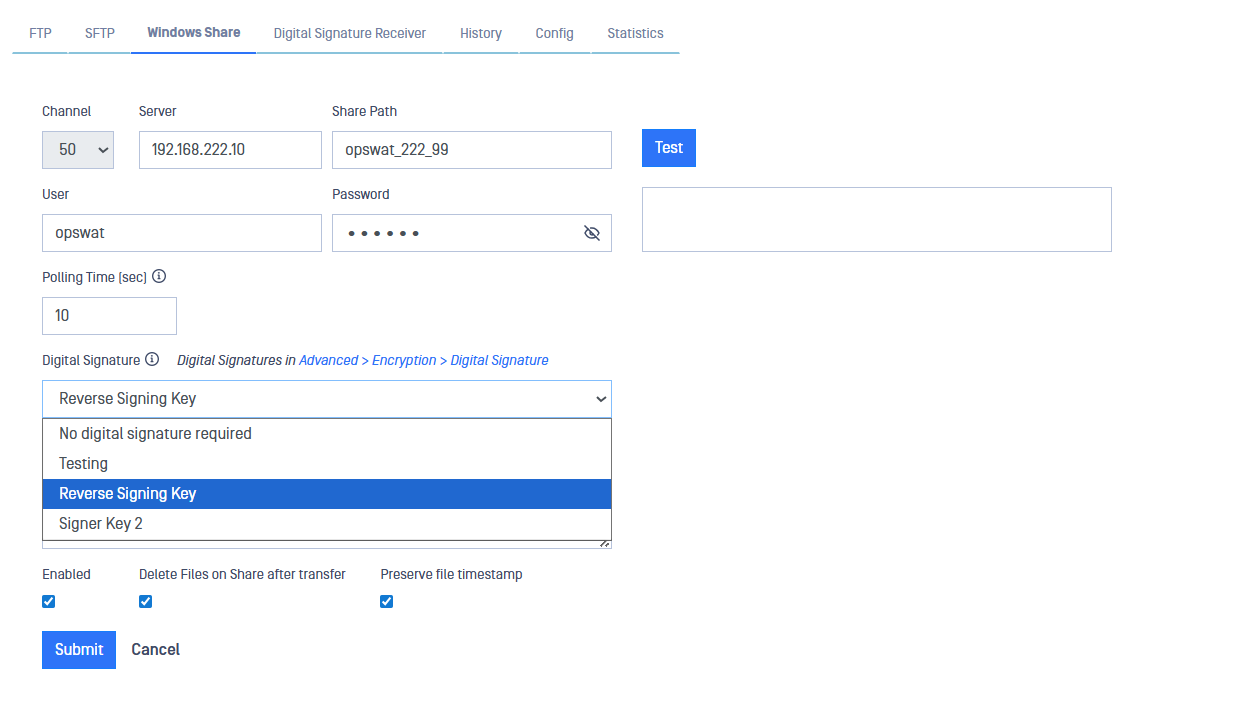
Digital Signature: Choose a Digital Signature to sign to sign the file transfer on the current channel. You can generate or import key pairs on the link next to the icon.
Enabled: File transfer will be enabled if this checkbox is ticked
Connection can be tested to validate the configuration by pressing Test button.
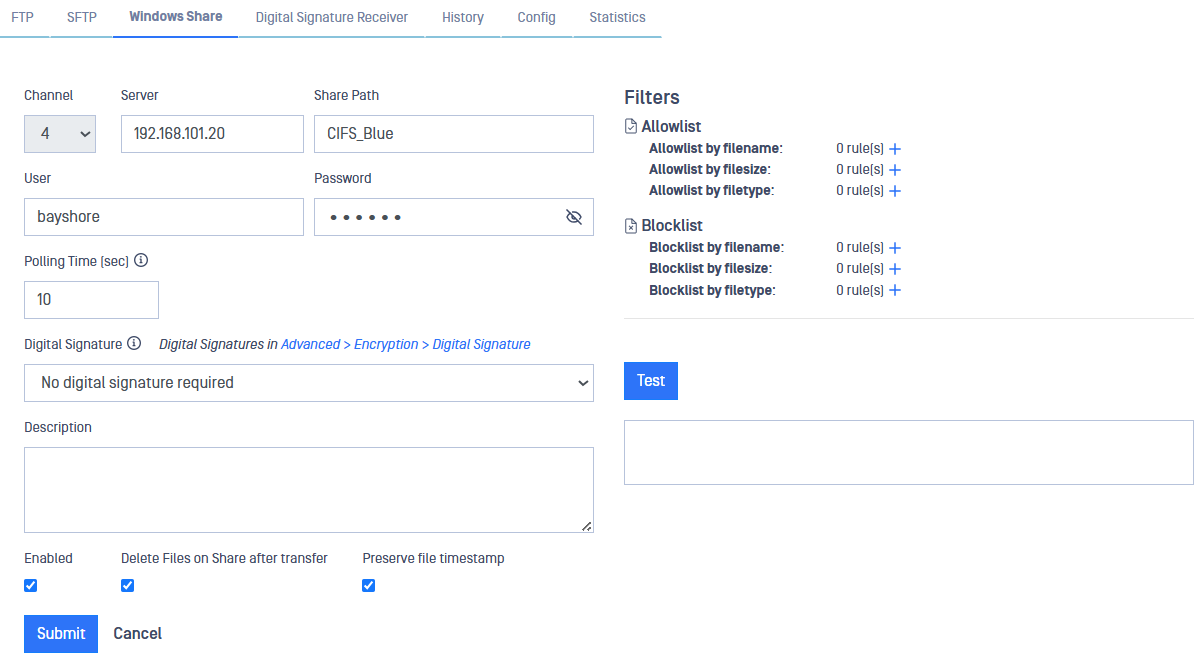
After filling in the fields, click on the Submit button to save configuration.
Mixed Format File Transfers
The Optical Diode allows the user to configure mixed file transfers. For instance a user can configure a WFS file share on the BLUE side and a FTP share on the RED side. The Optical Diode BLUE will take files from the Windows Share, transfer them to the Optical Diode RED then transfer the files to a FTP server configured on the RED side. To do that:
Configure your preferred file transfer protocol for the BLUE side and configure it as previously indicated.
Configure your preferred file transfer protocol for the RED side and configure it as previously indicated.
The Channel Number must be the same on both BLUE and RED sides.
Initiate your file transfer from the BLUE side and check the files have been received in the RED side.
File Transfer Filters
The Optical Diode provides the ability to Allow or Block files based on File Name, Size and Type. This feature is available for FTP, SFTP and Windows File Share formats. Filter configuration is required on the BLUE side only.
Click on the File Transfer link, select the FTP, SFTP or WFS label and then click on the Channel Number to be filtered.
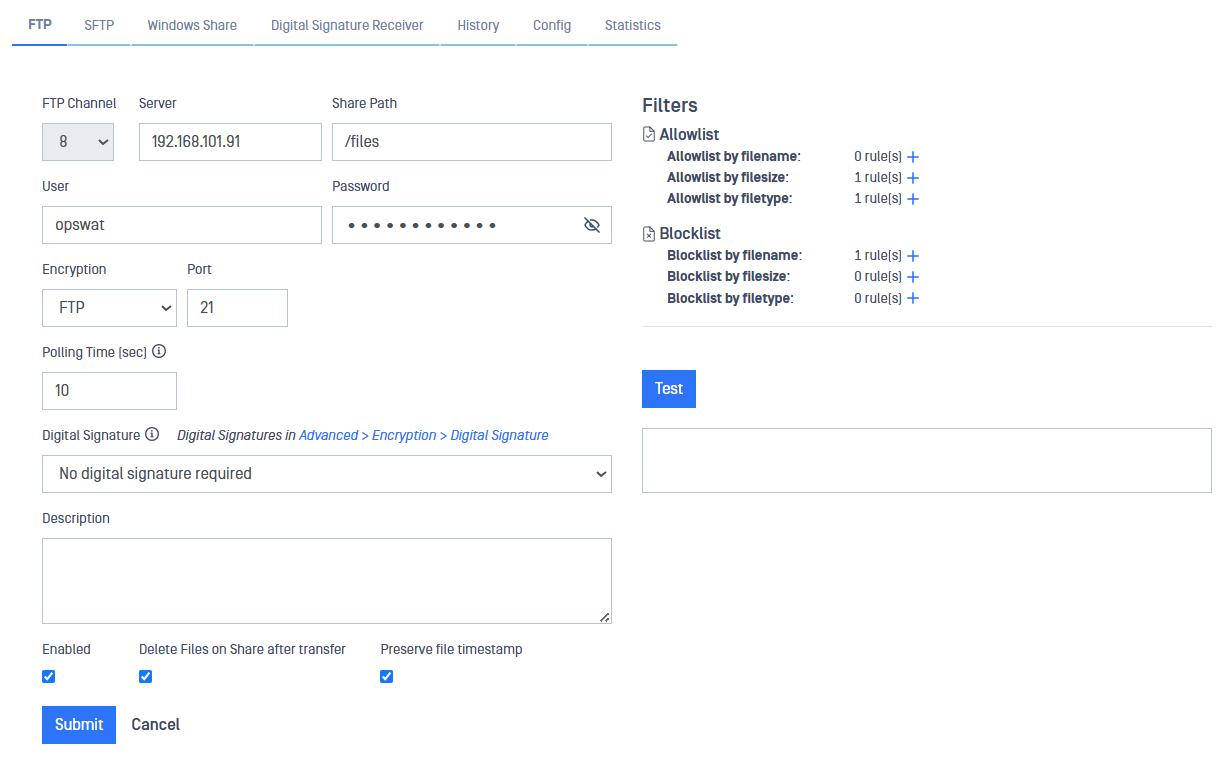
Click on "+" of the Allowlist/Blocklist filter to be configured.
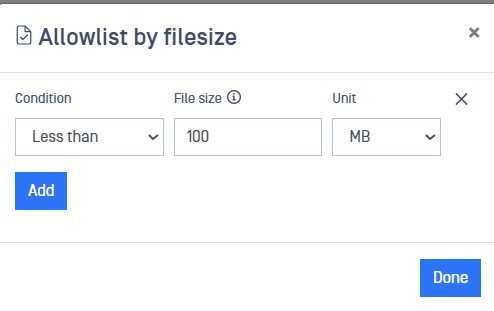
Allowlist by File Name: Must be a valid regular expression. Max length: 100 characters.
Allowlist by File Size: Valid range: 0 - 8589934591.
Allowlist by File Type: Must be a valid MIME type (example" 'application/JSON'). Max length: 100 characters.
Blocklist by File Name: Must be a valid regular expression. Max length: 100 characters.
Blocklist by File Size: Valid range: 0 - 8589934591.
Blocklist by File Type: Must be a valid MIME type (example" 'application/JSON'). Max length: 100 characters.
Historical Data
The Optical Diode keeps a record of the files transferred from BLUE to RED. To review the Historical data, click on the History tab within the File Transfer section.
Please note that File Transfer Historical Data is not stored in backups.
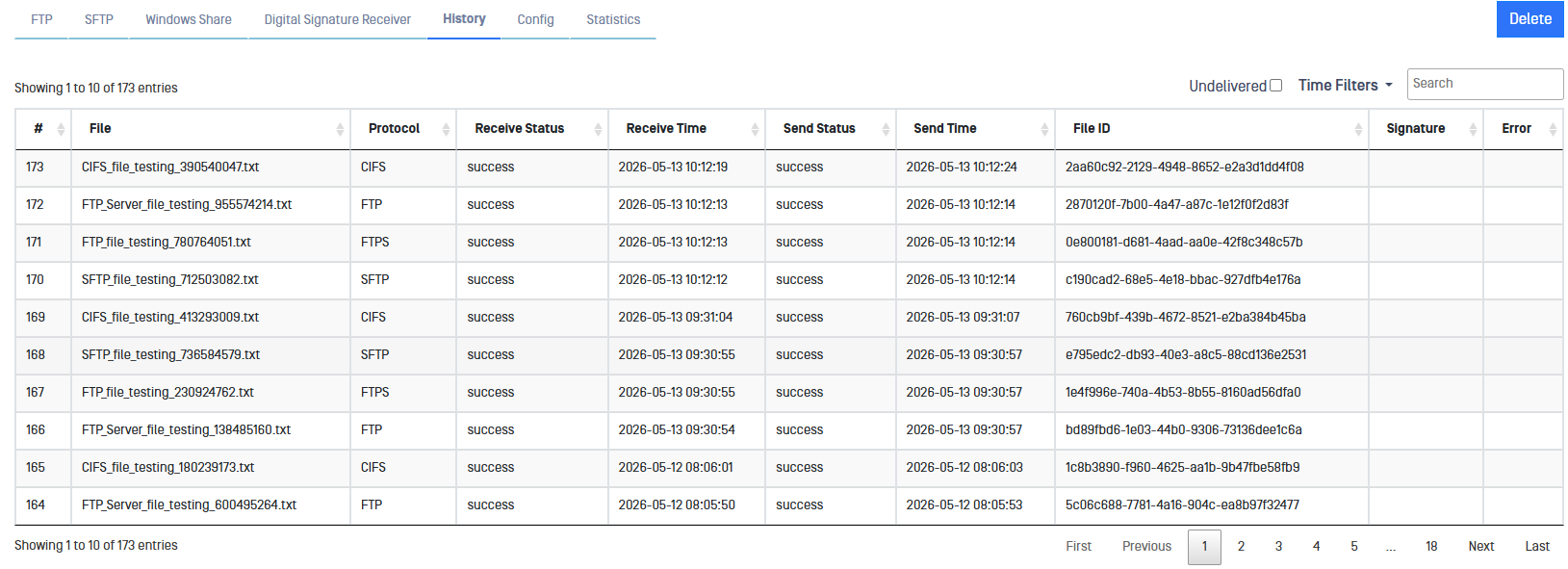
Once the data is loaded it can be filtered in several ways.
Undelivered: Only shows undelivered transfers. File haven't been received by RED side.
Time filters: Daily, weekly and monthly filters can be applied. A date range can also be defined.
Search box can be used to search for specific files by typing text.
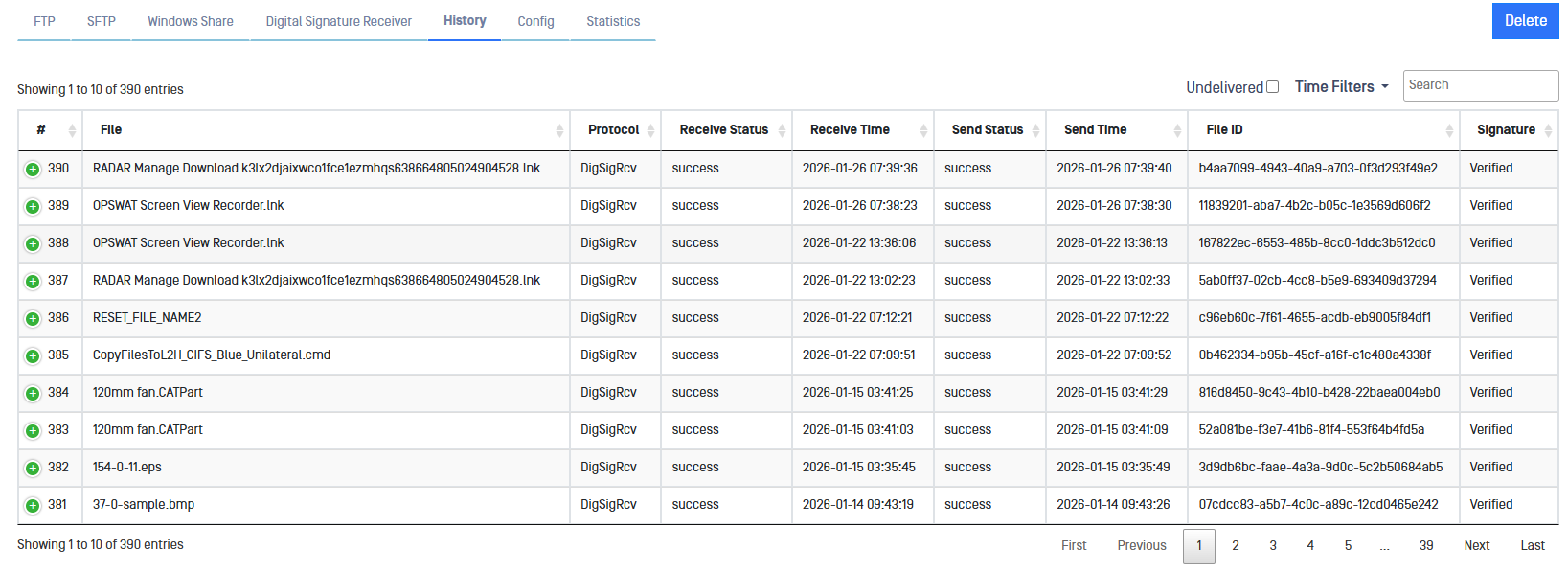
Please, notice that this information can be checked in both sides BLUE and RED.
File Transfer Priority
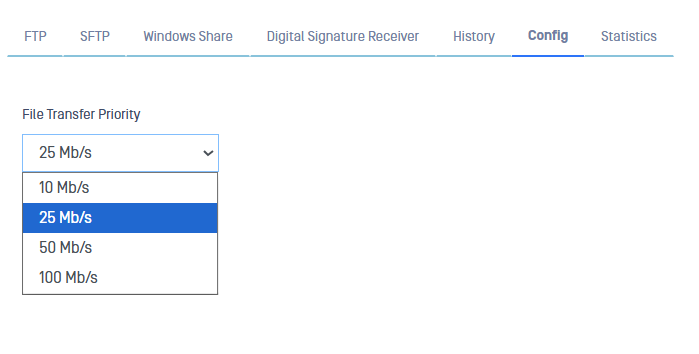
Optical Diode can be configured for transferring files from BLUE to RED. If Optical Diode is doing many file transfers, the transfers can consume bandwidth and other resources to the point that it encroaches on TCP Stream performance.
Optical Diode provides a priority mechanism (High, Medium, Low) designed to limit the resources consumed by File Transfer. This throttling mechanism can lower the impact of large volume file transfers as well as compensate for a RED destination File Server that operates slower than the BLUE source File Server.
Digital Signature and Verification
How it Works
MetaDefender Optical Diode can be configured to apply a digital signature on a file and validate the signature when transferring files between two sites or domains. The feature requires the use of two Optical Diode devices, one at Site A and another at Site B. The Optical Diode can be configured to perform one of the following options:
· Signing an incoming file
· Verifying a signature of an incoming file
· None of these actions (default)
Workflow Description
Obtain private/public signing key from a Certificate Authority or self-generated pair (Private/Public Key: Advanced->Encryption->Digital Signature). The private key is installed on Optical Diode BLUE A, while the Public key are installed on Optical Diode RED A, BLUE B and RED B.
BLUE A copies a file from a source File Server and signs its hashed (SHA256) content using a Private Key from Digital Signature store.
The file along with metadata, containing the signature is transferred from BLUE A to RED A. The hash and the signature are verified by RED A to ensure the data integrity of the file transfer.
The signed file, along with metadata is transferred from RED A, over the untrusted network to BLUE B. To ensure confidentiality, mutual TLS is employed. BLUE B receives the file, verifies the hash and signature to check its integrity. The file is transferred from BLUE B to RED B.
RED B verifies the signature by using the public key imported within the Digital Signature (Advanced -> Encryption -> Digital Signature).
Files with valid digital signatures are delivered from RED B to the destination File Server.
Rejected files are reported via syslog and discarded.
Configuration
BLUE A - Create/Export Signer Key
On BLUE A, Navigate to: Advanced>Encryption>Digital Signature Menu.
Select "Create Digital Signature Signer Key" or "Import Signer Key".
Assign a Friendly Name for "Create Digital Signature Signer Key".
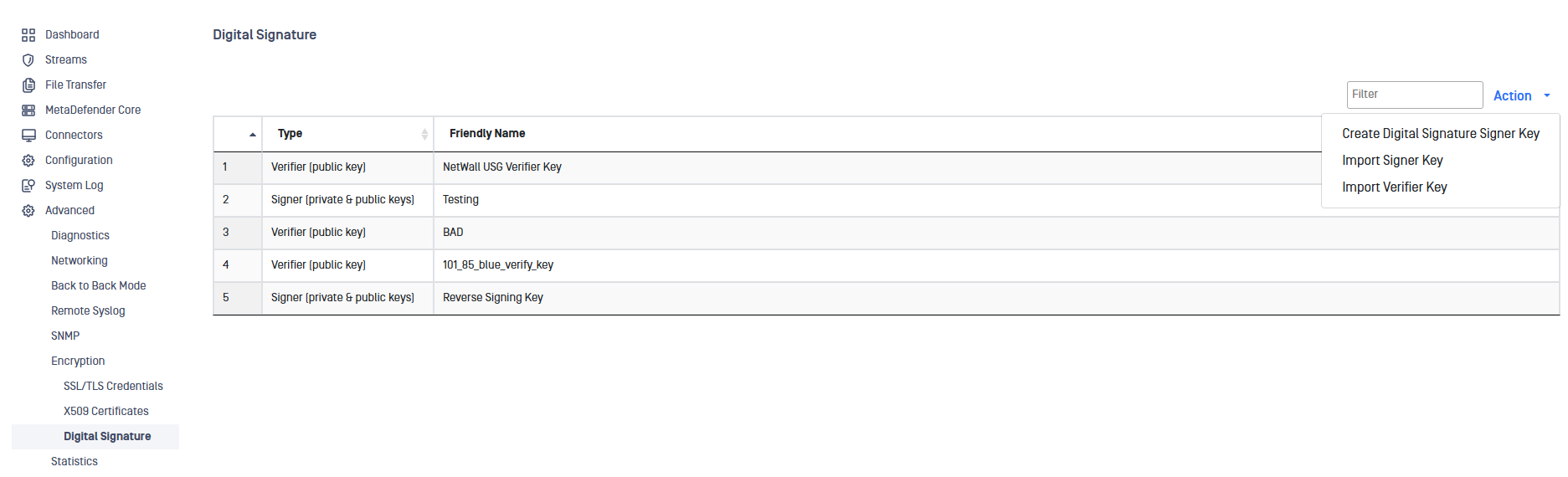
Select Signer Key just created or imported.
Export Signer Key (Public Key) to Desktop or Directory.
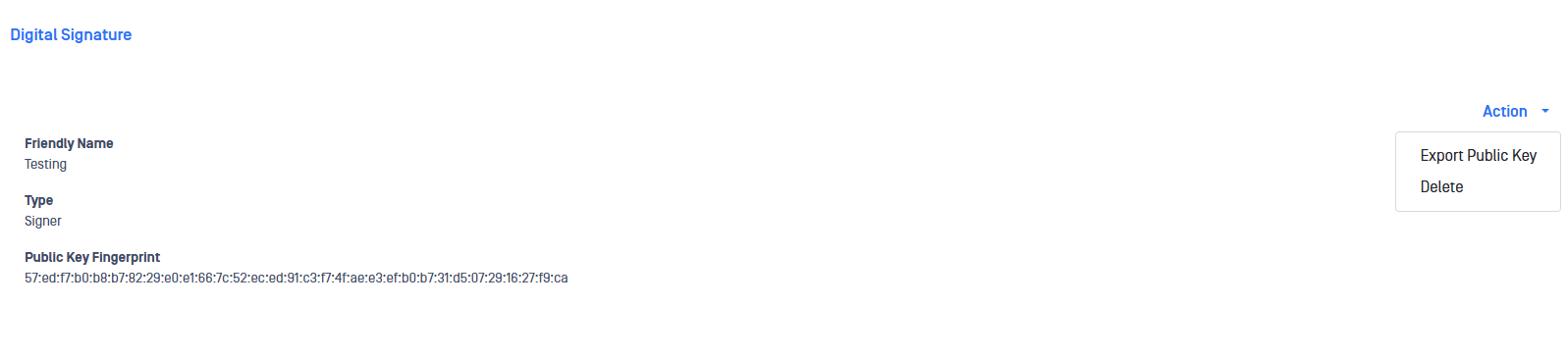
Signer Key (Public Key) must be imported on RED A, BLUE B and RED B.
BLUE A - Configure File Transfer
Navigate to: File Transfer and select File Transfer method (FTP, SFTP or Windows File Share).
Configure File Transfer channel as per instructions in previous FTP, SFTP or Windows File Share section.
Select previously created or imported Signer Key.
RED A - Create Digital Signature Forwarder
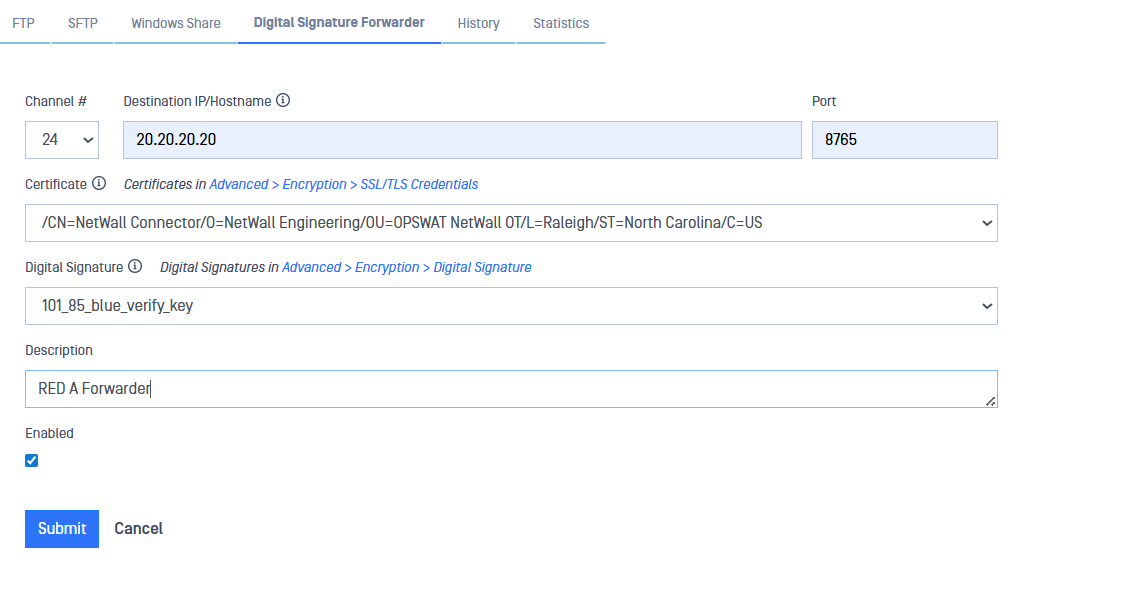
Navigate to File Transfer and select the Digital Signature Forwarder tab.
Select Add Forwarder.
Fill in fields:
Channel Number: Must match Channel Number assigned on BLUE A
Port: Port defined on BLUE B
Destination IP/Hostname: Destination IP Address or Hostname on BLUE B
Certificate: Select a Certificate to be use for Digital Signature. Certificates in Advanced > Encryption > SSL/TLS Credentials
Digital Signature: Select a Digital Signature for the Forwarder. Digital Signatures in Advanced > Encryption > Digital Signature
Description: Friendly name
BLUE B - Create Digital Signature Receiver
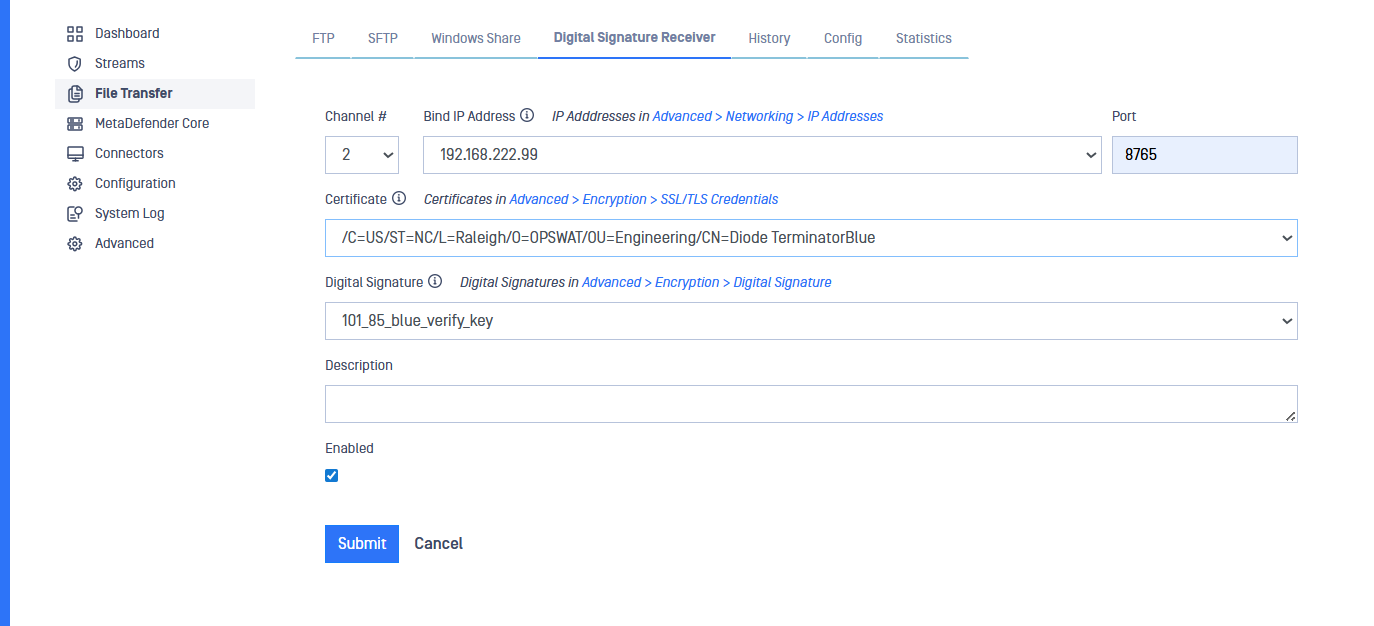
On BLUE B navigate to File Transfer>Digital Signature Receiver and select Action Item "Add Receiver" and fill in the following:
Channel: Select the assigned channel number. The assigned channel on BLUE B does not have to match the assigned channel on BLUE A AND RED A.
Bind IP Address: Select an IP Address in Advanced>Networking>IP Addresses
Port: Listening port
Certificate: Select a certificate in Advanced>Encryption>SSL/TLS Certificates
Digital Signature: Select Digital Signature in Advanced>Encryption>Digital Signature
Description: Friendly description
BLUE B - Export Credentials to RED A
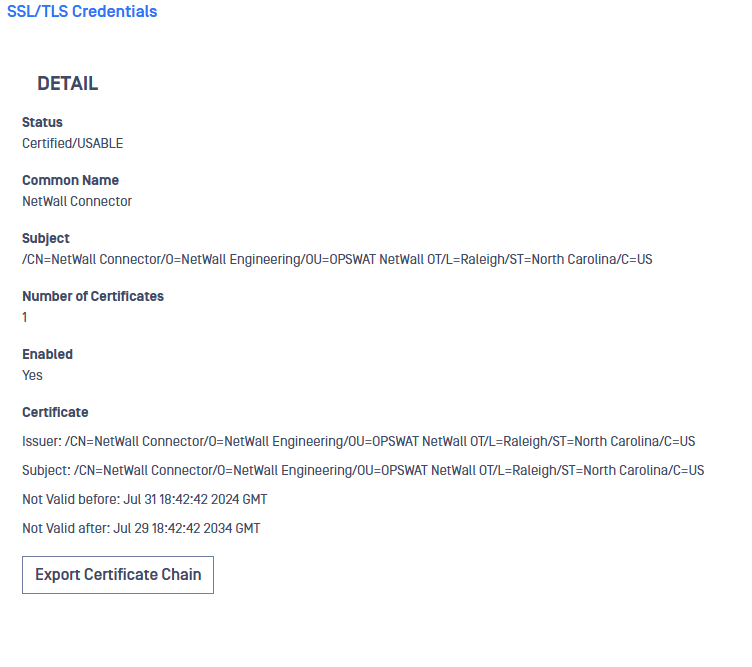
Navigate to Advanced/Encryption/SSL/TLS Credentials
Select Credentials
Select Export Credentials and save to Desktop or Directory
RED A - Import BLUE B Credentials
Navigate to Advanced/Encryption/SSL/TLS Credentials
Select Action Item Import Keypair
Import BLUE 2 Credentials from Desktop or directory

Repeat Export/Import process inversely. Export RED A credentials and import to BLUE B.
RED B - Configure File Transfer
Navigate to: File Transfer and select File Transfer method (FTP, SFTP or Windows File Share).
Configure File Transfer channel as per instructions in previous FTP, SFTP or Windows File Share section.
Select Digital Signature from Digital Signatures in Advanced > Encryption > Digital Signature
Channel number must be the same on BLUE B and RED B.
Digital Signature must be the same on BLUE A/RED A and BLUE B/RED B