How to setup auto deactivate license for MD Core container in AWS ECS with Lambda function?

Info:

This article apply for MD Core container in AWS ECS

Background

There are situations in ECS deployment that the deployment-ids within a license key get zombie as the container is terminated but it could not properly deactivate that deployment-id.

Goal:

When an MD Core task starts, record its deployment ID; when the task stops (scale-in, crash, OOM, deploy), deactivate that deployment reliably—even if the container can’t run its own shutdown hook.

1 - Architecture (at a glance)

  • Trigger: EventBridge rule on ECS Task State Change (we filter by desiredStatus for speed).

  • Lambda (single function):

    • On desiredStatus=RUNNING → wait until lastStatus=RUNNING, call MD Core Admin APIGET http://<task-private-ip>:8008/admin/license (header apikey: <MDCORE_APIKEY>) → read deployment.

    • Store mapping { task_arn → deployment } in DynamoDB (TTL’d).

    • On desiredStatus=STOPPED → wait until lastStatus=STOPPED, read activation key + deployment → call GET https://activation.dl.opswat.com/deactivation?key=<activation-key>&deployment=<deployment>.

  • Secrets: Activation key and Admin API key live in AWS Secrets Manager; they are injected into the Task Definition as environment secrets (not plain env).

  • Networking: Lambda is placed in the same VPC as ECS and allowed to reach the task’s private IP on TCP/8008.

2 - Prerequisites

  • ECS Fargate service for MD Core (container name recommended: mdcore).

  • VPC with private subnets and either a NAT gateway (or VPC endpoints for Secrets Manager & DynamoDB).

  • Basic AWS permissions to create Lambda, EventBridge rules, DynamoDB table, and Secrets.

3 - Store secrets in AWS Secrets Manager

Create two secrets (names are examples; choose your own):

# 1) MD Core activation key (for deactivation calls) aws secretsmanager create-secret \ --name mdcore/license-key \ --secret-string '<YOUR_ACTIVATION_KEY>' # 2) MD Core Admin API key (for /admin/license) aws secretsmanager create-secret \ --name mdcore/admin-apikey \ --secret-string '<STRONG_RANDOM_APIKEY>'

4 - Update the Task Definition (container mdcore)

Add environment secrets:

  • MDCORE_LICENSE_KEY → value from Secrets Manager mdcore/license-key

  • MDCORE_APIKEY → value from Secrets Manager mdcore/admin-apikey

Tip: You do not need to expose port 8008 externally. Lambda will call the task’s private IP on port 8008.

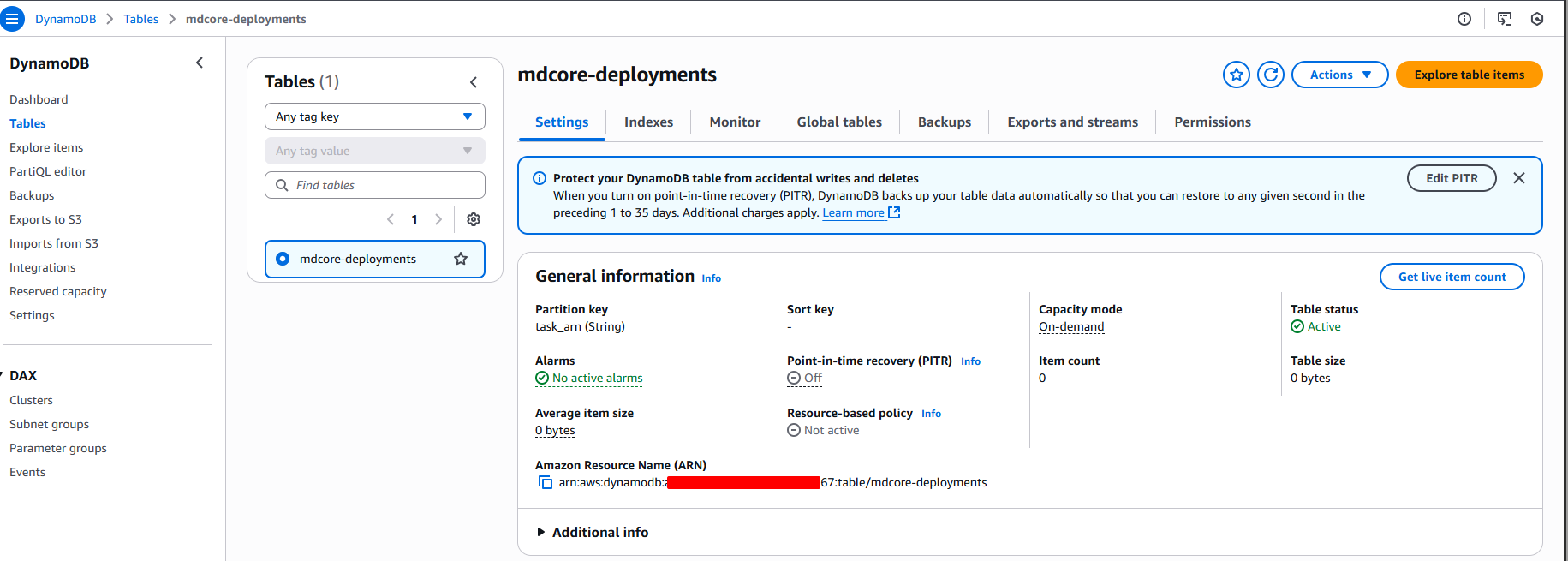
5 - Create the DynamoDB table (idempotency & mapping)

aws dynamodb create-table \ --table-name mdcore-deployments \ --attribute-definitions AttributeName=task_arn,AttributeType=S \ --key-schema AttributeName=task_arn,KeyType=HASH \ --billing-mode PAY_PER_REQUEST

Then enable TTL on attribute ttl (Console → DynamoDB → Table → TTL).


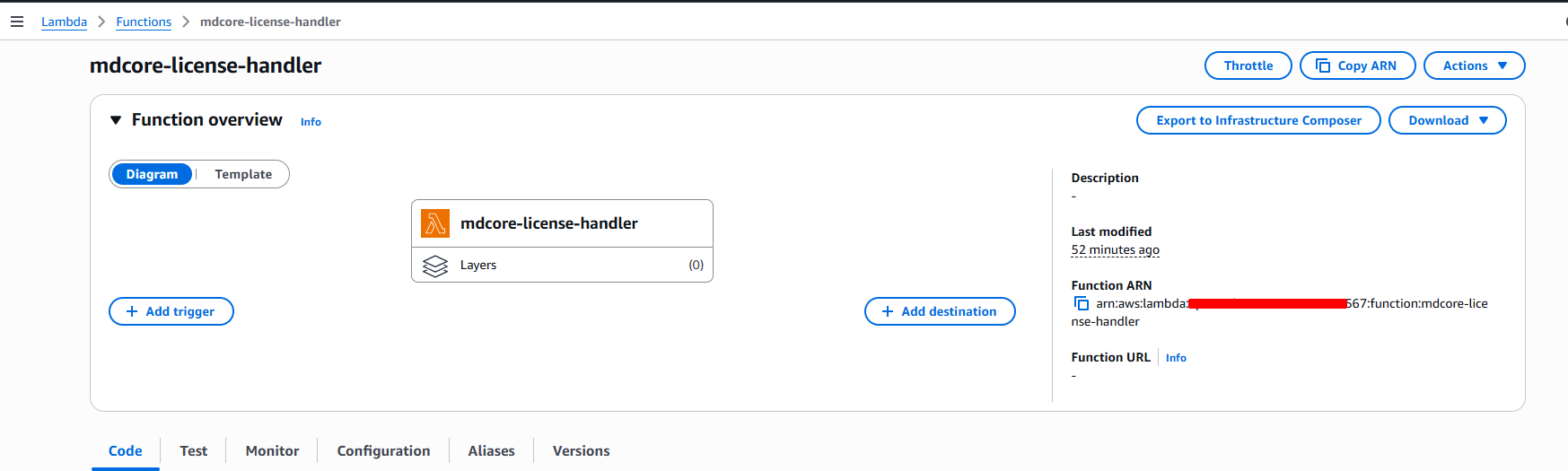
6 - Create the Lambda function

A. Basics

  • Author from scratch → Name: mdcore-license-handler

  • Runtime: Python 3.11, Architecture: x86_64

  • Create.

B. VPC

  • Configuration → VPC → Edit

    • Select the same VPC and private subnets as ECS.

    • Security group for Lambda: allow egress to the ECS task SG.

  • ECS task SG: allow inbound TCP 8008 from the Lambda SG.

C. Environment variables

DDB_TABLE = mdcore-deployments MDCORE_CONTAINER_NAME = mdcore MDCORE_APIKEY_NAME = MDCORE_APIKEY MDCORE_ACTIVATION_KEY_NAME = MDCORE_LICENSE_KEY MDCORE_ADMIN_PORT = 8008 WAIT_RUNNING_SEC = 120 WAIT_STOPPED_SEC = 90 DEACTIVATE_URL = https://activation.dl.opswat.com/deactivation

D. Permissions (IAM)

From Lambda → Configuration → Permissions → click the Role nameAdd permissions → Create inline policy → JSON:

{ "Version": "2012-10-17", "Statement": [ { "Effect": "Allow", "Action":["ecs:DescribeTasks","ecs:DescribeTaskDefinition"], "Resource": "*" }, { "Effect": "Allow", "Action":["secretsmanager:GetSecretValue"], "Resource": "*" }, { "Effect": "Allow", "Action":["dynamodb:GetItem","dynamodb:PutItem","dynamodb:UpdateItem"], "Resource": "*" }, { "Effect": "Allow", "Action": ["logs:CreateLogGroup","logs:CreateLogStream","logs:PutLogEvents"], "Resource": "*" } ] }

Later, tighten Resource to specific ARNs (table + secrets). If secrets use a CMK, also grant kms:Decrypt.

E. Code (paste into lambda_function.py, handler = lambda_function.handler)

import os, time, json, urllib.request, urllib.parse import boto3 from botocore.exceptions import ClientError ecs = boto3.client('ecs') secrets = boto3.client('secretsmanager') ddb = boto3.resource('dynamodb') table = ddb.Table(os.environ['DDB_TABLE']) MDCORE_CONTAINER = os.environ.get('MDCORE_CONTAINER_NAME', 'mdcore') APIKEY_ENV = os.environ.get('MDCORE_APIKEY_NAME', 'MDCORE_APIKEY') ACTKEY_ENV = os.environ.get('MDCORE_ACTIVATION_KEY_NAME', 'MDCORE_LICENSE_KEY') ADMIN_PORT = int(os.environ.get('MDCORE_ADMIN_PORT', '8008')) DEACTIVATE_URL = os.environ.get('DEACTIVATE_URL', 'https://activation.dl.opswat.com/deactivation') WAIT_RUNNING_SEC = int(os.environ.get('WAIT_RUNNING_SEC', '120')) WAIT_STOPPED_SEC = int(os.environ.get('WAIT_STOPPED_SEC', '90')) def _get_secret(maybe_arn): if not maybe_arn: return None v = secrets.get_secret_value(SecretId=maybe_arn) return v.get('SecretString') or v.get('SecretBinary') def _env_from_taskdef(taskdef_arn, name, container_name): td = ecs.describe_task_definition(taskDefinition=taskdef_arn)['taskDefinition'] cdefs = td.get('containerDefinitions', []) c = next((x for x in cdefs if x.get('name') == container_name), (cdefs[0] if cdefs else {})) for e in c.get('environment', []): if e.get('name') == name: return e.get('value') for s in c.get('secrets', []): if s.get('name') == name: return _get_secret(s.get('valueFrom')) return None def _describe_task(cluster_arn, task_arn): t = ecs.describe_tasks(cluster=cluster_arn, tasks=[task_arn])['tasks'][0] last = t.get('lastStatus') taskdef_arn = t.get('taskDefinitionArn') ip = None for att in t.get('attachments', []): if att.get('type') == 'ElasticNetworkInterface': for d in att.get('details', []): if d.get('name') == 'privateIPv4Address': ip = d.get('value'); break return last, taskdef_arn, ip def _wait_until(cluster_arn, task_arn, want_status, timeout_sec): t0 = time.time() last, taskdef, ip = None, None, None while time.time() - t0 < timeout_sec: last, taskdef, ip = _describe_task(cluster_arn, task_arn) if last == want_status: return last, taskdef, ip time.sleep(3) return last, taskdef, ip def _call_admin_license(ip, apikey, retries=20, sleep=3): url = f'http://{ip}:{ADMIN_PORT}/admin/license' for _ in range(retries): try: req = urllib.request.Request(url, method='GET', headers={'apikey': apikey}) with urllib.request.urlopen(req, timeout=5) as resp: if resp.status == 200: return json.loads(resp.read().decode()) except Exception: time.sleep(sleep) raise RuntimeError("Cannot query /admin/license (timeout)") def _put_mapping(task_arn, container_name, cluster_arn, taskdef_arn, ip, deployment): table.put_item(Item={ 'task_arn': task_arn, 'container_name': container_name, 'cluster_arn': cluster_arn, 'taskdef_arn': taskdef_arn, 'private_ip': ip or '', 'deployment': deployment, 'created_at': int(time.time()), 'status': 'ACTIVE', 'ttl': int(time.time()) + 14*24*3600 }) def _get_mapping(task_arn): r = table.get_item(Key={'task_arn': task_arn}) return r.get('Item') def _mark_deactivated(task_arn): table.update_item( Key={'task_arn': task_arn}, UpdateExpression="SET #s=:s, deactivated_at=:t", ExpressionAttributeNames={'#s': 'status'}, ExpressionAttributeValues={':s': 'DEACTIVATED', ':t': int(time.time())} ) def _deactivate(activation_key, deployment): q = f"{DEACTIVATE_URL}?key={urllib.parse.quote(activation_key)}&deployment={urllib.parse.quote(deployment)}" req = urllib.request.Request(q, method='GET') with urllib.request.urlopen(req, timeout=10) as resp: if resp.status not in (200, 204): body = resp.read().decode() raise RuntimeError(f"Deactivate failed: {resp.status} {body}") def handler(event, _ctx): d = event.get('detail', {}) desired = d.get('desiredStatus') cluster_arn = d.get('clusterArn') task_arn = d.get('taskArn') if not (cluster_arn and task_arn and desired): return {"skipped": True, "reason": "missing fields"} last, taskdef_arn, ip = _describe_task(cluster_arn, task_arn) if desired == 'RUNNING': last, taskdef_arn, ip = _wait_until(cluster_arn, task_arn, 'RUNNING', WAIT_RUNNING_SEC) apikey = _env_from_taskdef(taskdef_arn, APIKEY_ENV, MDCORE_CONTAINER) if not apikey: raise RuntimeError(f"Missing API key env {APIKEY_ENV}") t0 = time.time() while not ip and time.time() - t0 < 60: time.sleep(3) _, _, ip = _describe_task(cluster_arn, task_arn) if not ip: raise RuntimeError("No private IP; cannot reach admin port") lic = _call_admin_license(ip, apikey) dep = lic.get('deployment') if not dep: raise RuntimeError("No 'deployment' in /admin/license") _put_mapping(task_arn, MDCORE_CONTAINER, cluster_arn, taskdef_arn, ip, dep) return {"status": "mapped", "desired": desired, "last": last, "deployment": dep} if desired == 'STOPPED': item = _get_mapping(task_arn) if not item or not item.get('deployment'): return {"status": "no-mapping", "desired": desired, "last": last} dep = item['deployment'] act_key = _env_from_taskdef(taskdef_arn, ACTKEY_ENV, MDCORE_CONTAINER) if not act_key: raise RuntimeError(f"Missing activation key env {ACTKEY_ENV}") last, _, _ = _wait_until(cluster_arn, task_arn, 'STOPPED', WAIT_STOPPED_SEC) _deactivate(act_key, dep) _mark_deactivated(task_arn) return {"status": "deactivated", "desired": desired, "last": last} return {"skipped": True, "reason": f"desired={desired}"}

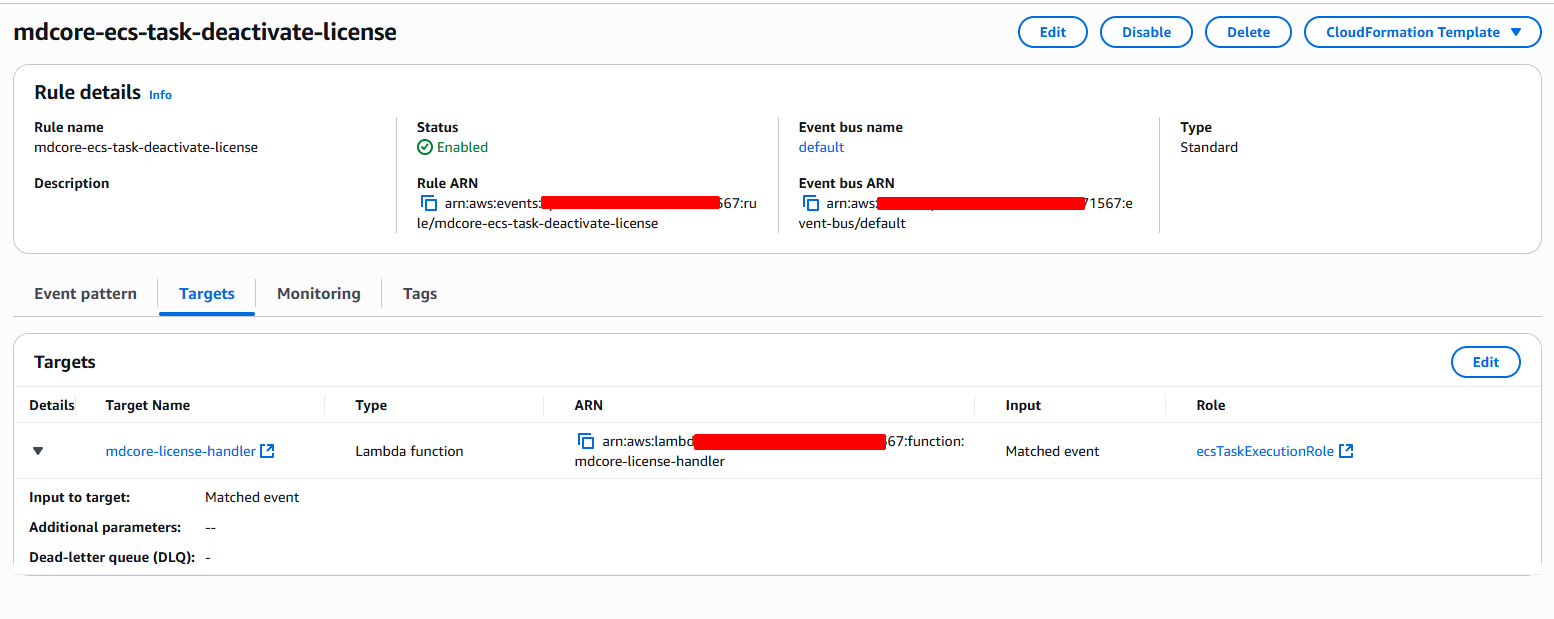
7 - Create the EventBridge rule

Console → EventBridge → Rules → Create rule → Rule with an event patternAWS services → Service: Elastic Container Service (ECS) → Event type: ECS Task State ChangeSwitch to JSON editor and paste:

{ "source": ["aws.ecs"], "detail-type": ["ECS Task State Change"], "detail": { "clusterArn": ["arn:aws:ecs:<region>:<acct>:cluster/<your-cluster>"], "group": ["service:<your-mdcore-service>"], "desiredStatus": ["RUNNING","STOPPED"] } }

Target: Lambda function → select mdcore-license-handler. In Additional settings: enable a DLQ (SQS) and keep default retries.

8 - Test & validate

  1. Scale service to 0 and back to 1:

  • On scale-up, CloudWatch Logs should show: status=mapped ... deployment=<id>. Verify DynamoDB row { task_arn, deployment, status=ACTIVE }.

  • On scale-in/stop, Logs should show: status=deactivated. Row updated to status=DEACTIVATED.

  1. Manual curl (optional)

  • Get deployment from inside the task:

curl -H "apikey: $MDCORE_APIKEY" http://localhost:8008/admin/license
  • Expected JSON contains "deployment": "<MSCL...>".

  1. Security Group check

  • If mapping fails, ensure Lambda SG - ECS task SG allows TCP/8008

9 - Troubleshooting quick list

  • EventBridge rule not firing: wrong region/bus; pattern mismatch (check clusterArn/group); use CloudWatch “Metrics for matched events”.

  • Mapping fails (RUNNING): Lambda not in VPC / no IP on task yet / SG not allowing 8008 / wrong MDCORE_APIKEY_NAME.

  • Deactivation fails (STOPPED): No DDB mapping (task died before RUNNING), wrong MDCORE_LICENSE_KEY secret, outbound internet blocked (need NAT for the activation URL) or corporate proxy.

  • Timeouts: Increase WAIT_RUNNING_SEC / WAIT_STOPPED_SEC; keep EventBridge target retry window ≥ 1h.

10 - Hardening & Ops

  • Least privilege: restrict IAM to specific ARNs; add kms:Decrypt if secrets use a CMK.

  • Observability: add CloudWatch metric filters for "Deactivate failed" and alarm.

  • Idempotency: deactivation endpoint should be safe to call multiple times; DDB state prevents repeats.

  • Cost: all serverless; negligible under normal loads.

11 - Alternative "sidecar register" (if opening 8008 to Lambda is hard)

Add a tiny sidecar container that waits for MD Core to be ready, calls /admin/license, and writes the mapping directly to DynamoDB (using the task role). Then the Lambda only needs to handle STOPPED events to deactivate. This avoids Lambda→8008 traffic.

Support:

If Further Assistance is required, please proceed to log a support case or chatting with our support engineer.