Using Kubernetes technology provides us with some features that distinct it from other type of deployments. These are the main features:
Service discovery and load balancing. See Installing MetaDefender Core in K8S
Storage orchestration. Allows you to automatically mount a storage system. See Storage Configuration on K8S
Automated rollouts and rollbacks. See Upgrade/Deployment Strategy on K8S
Automatic bin packing. You tell Kubernetes how much CPU and memory (RAM) each container needs.
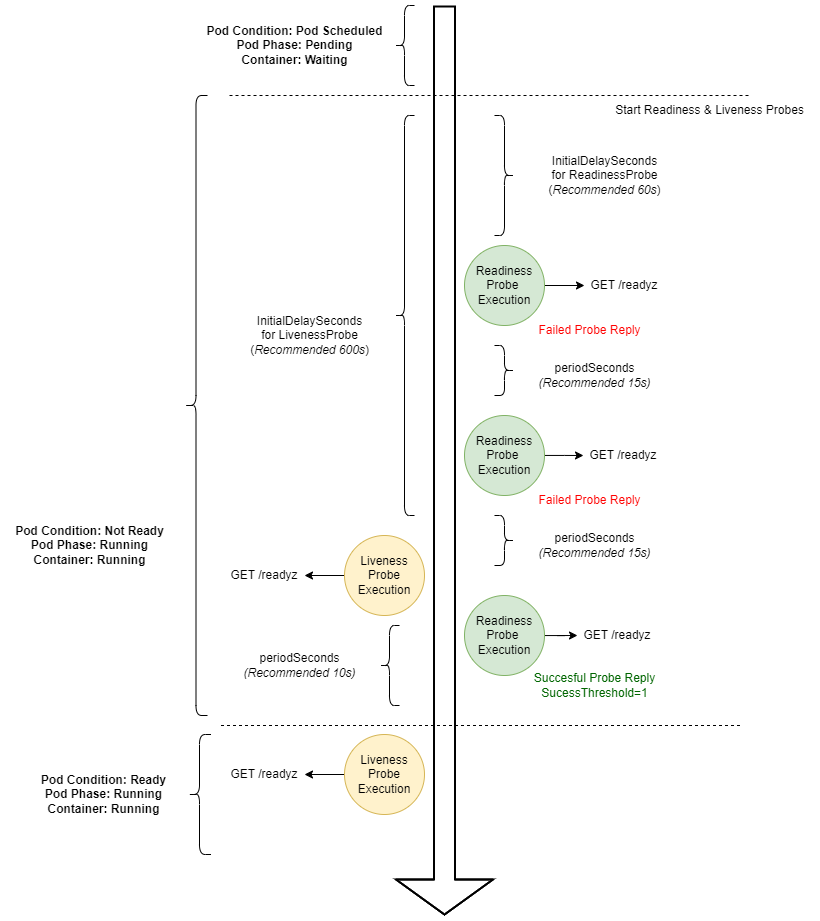
Self-healing. Kubernetes restarts containers that fail, replaces containers, kills containers that don't respond to your user-defined health check, and doesn't advertise them to clients until they are ready to serve. Se Kubernetes Probes explained below
Secret and configuration management. Kubernetes lets you store and manage sensitive information. See Kubernetes Components
Horizontal scaling. Scale your application up and down. See Scaling K8S Cluster
There are recommended configuration for each of the features to use by default when deploying MetaDefender Core in a Kubernetes cluster.
Kubernetes Probes
The Kubernetes probes are needed to control the correct behavior of the application on this environment. Each probe need to use the health check endpoint GET - Get health check status (/readyz)
Readiness Probe ( Check /readyz endpoint to know if the Health Check is OK )
initialDelaySeconds= 60periodSeconds= 10successThreshold= 1timeoutSeconds= 10
Liveness Probe ( Check /readyz endpoint to know if the Health Check is OK after Pod is ready)
initialDelaySeconds= 90timeoutSeconds= 10periodSeconds= 10failureThreshold= 3